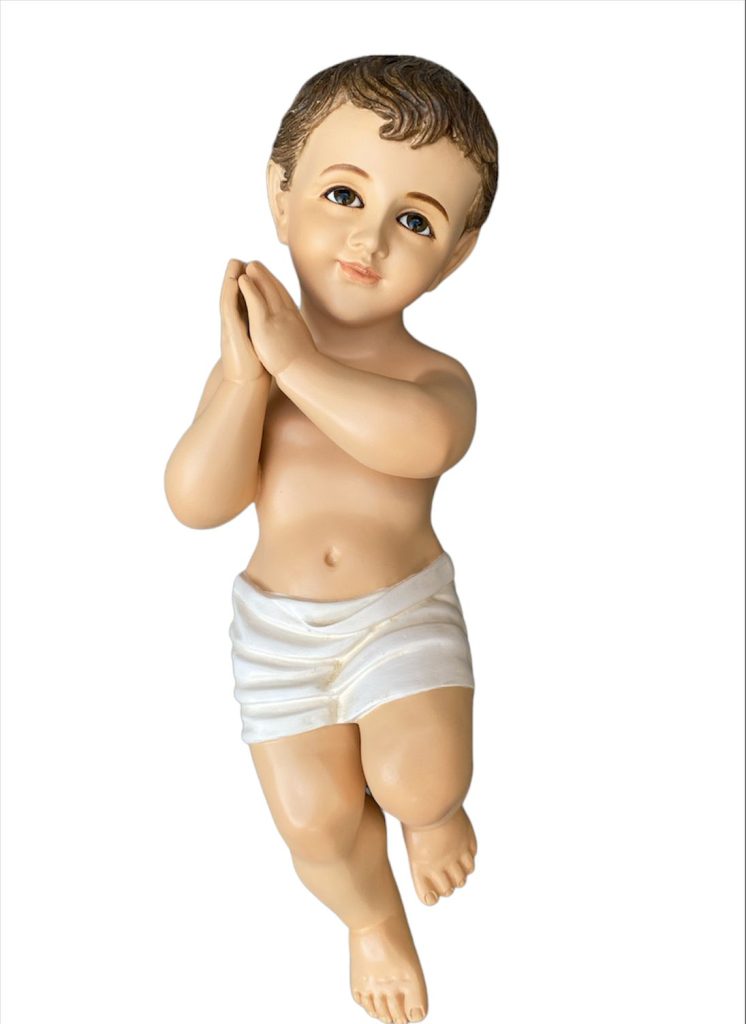
In our workshop, we’ve learned that the right Baby Belen doesn’t shout. It steadies the room. It invites the faithful to slow down, to look closer, and to feel—through proportion, expression, and finish—that the Holy Family story is not distant. Baby Belen 21″ is designed for that kind of presence: intimate, life-size in spirit, and devotional in every line.
Craftsmanship/material
We approach sacred sculpture the way our Italian-trained artisans were taught: with discipline at the model stage, precision through casting, and restraint in finishing. For a piece like Baby Belen 21″, the goal is clarity—how the infant’s face turns toward tenderness, how the body’s modeling reads at both close and chapel distance, and how the surface treatment supports the feeling of softness without losing definition.
Our atelier typically works through a careful workflow—sculpting and refining the form, preparing the piece for production, then finishing and polishing so the final surface carries a dignified, museum-appropriate calm. When restoration heritage matters, it shows in the edges: clean transitions, controlled textures, and a finish that holds up to real-world viewing and handling.
Religious symbolism
Baby Belen is more than an infant figure. It’s a devotional focal point that carries the tenderness of the Incarnation into the physical space. In our experience, the most successful Baby Belen sculptures communicate three things at once: the intimacy of the child, the sacredness of the moment, and the quiet dignity that makes the figure suitable for prayer.
We pay close attention to expression and proportion because those are the cues people respond to instinctively. A well-made Baby Belen helps the viewer feel that the story is present—gentle, holy, and close enough to speak to the heart.
Placement/use
Choosing placement is where a sculpture becomes part of worship rather than decoration. For Baby Belen 21″, we recommend thinking in terms of sightlines and ritual use: where people will naturally pause, where the figure will catch light without glare, and how the surrounding elements support the devotional focus.
- Chapel or sanctuary: place it where congregants can see it during moments of reflection—near a side altar, devotional niche, or a dedicated nativity display area.
- Home shrine: choose a stable, respectful location—on a dedicated shelf or pedestal—so the figure remains a daily point of prayer.
- Curated collections: position it to read clearly from both a standing and seated viewpoint, with enough space around the figure to let the form breathe.
If you’re working with clergy, designers, or procurement teams, we also help you consider how the piece will integrate with existing sacred-space elements—so the Baby Belen feels intentional, not accidental.
Care
Beautiful devotional sculpture deserves practical care. Our artisans typically recommend gentle, consistent maintenance that preserves the surface treatment and keeps details crisp over time.
- Dusting: use a soft, dry cloth or a very gentle brush to remove dust without rubbing at fine details.
- Cleaning: avoid harsh chemicals and abrasive materials; if cleaning is needed, we can advise on the safest approach for the specific surface finish.
- Environment: keep the sculpture away from excessive moisture, direct heat sources, and areas with heavy smoke or frequent strong drafts.
- Handling: whenever possible, move the piece by supporting the base or stable structural points—never by delicate protrusions.
With proper care, a Baby Belen can remain a steady presence for years—its tenderness preserved, its details legible, its finish calm.
FAQ
-
Is Baby Belen 21″ sized for a chapel display or more for home devotion?
Both, depending on your sightlines and the surrounding elements. In our workshop, we treat 21″ as a strong devotional scale—clear enough to read with dignity in a chapel setting, yet intimate enough for a home shrine. For a chapel, we recommend placing it where people naturally pause; for home, we suggest a dedicated pedestal or shelf so it remains a consistent focal point.
-
What should we consider when choosing a Baby Belen for a nativity or Holy Family arrangement?
We look at harmony first: how the figure’s presence balances with other pieces, how the viewing distance affects facial clarity, and how the finish responds to the room’s light. If you’re building a set, we also consider spacing—so the Baby Belen reads as the heart of the arrangement rather than competing with surrounding figures.
-
How do we protect the sculpture’s surface finish over time?
Our artisans recommend gentle dusting with a soft, dry cloth and avoiding harsh cleaners. Keep the piece away from moisture, direct heat, and smoke-heavy environments. If you’re installing it in a public space, we can advise on a maintenance routine that fits your setting—so the surface treatment stays dignified and the details remain crisp.
-
Can our studio help with placement planning for a chapel or niche?
Yes. We often work with clergy and designers to think through sightlines, lighting behavior, and how the sculpture will be approached during prayer. Even small adjustments—like shifting the piece slightly higher or ensuring it’s not in glare—can make the difference between a figure that’s merely seen and one that truly invites devotion.
-
Do you offer guidance for commissioning a larger or more integrated sacred-space presentation?
When a space calls for more scale or a more complete ensemble, our studio can discuss commissioning options. We’re used to sacred-space work—matching proportions, planning bases or plinths, and coordinating finishing so the final presentation feels unified. If you tell us your space and intent, we’ll guide you toward a solution that fits the worship context.
Inquire about this sculpture
Inquire about this sculpture
This story accompanies the sculpture Baby Belen 21″ Sculpture in our catalog.