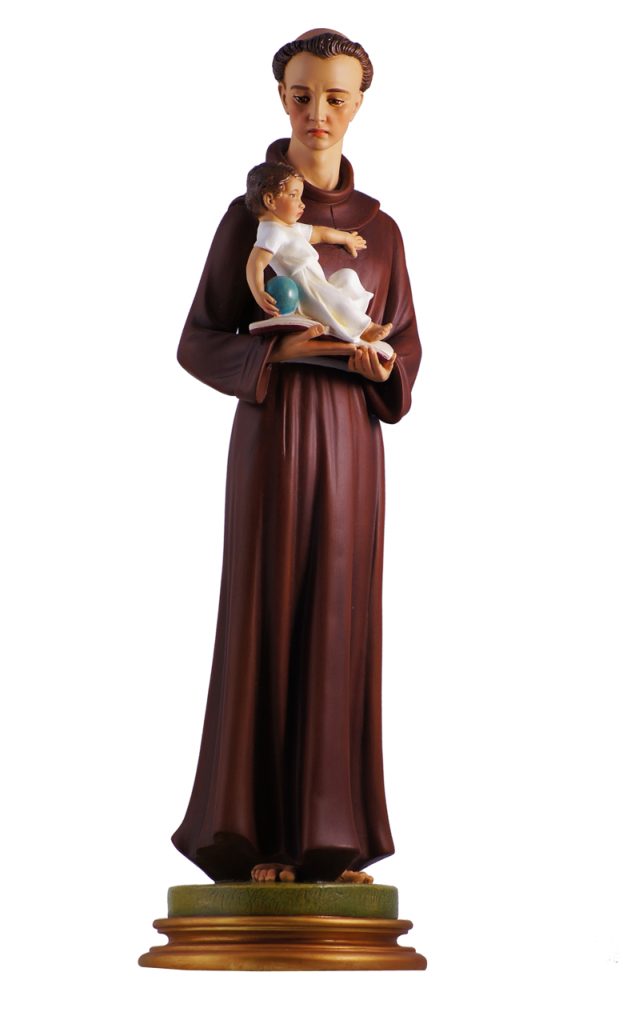
When people ask us for a St. Anthony sculpture, they’re usually looking for more than a likeness. They want a presence—something that steadies the eye, supports prayer, and belongs to the room the way a candle belongs to a vigil. In our workshop, we treat every saint’s figure as a sacred focal point: proportioned with care, finished for depth, and made to be lived with.
Craftsmanship and material character
Our artisans—Italian-trained and grounded in decades of religious sculpture—approach each commission with the discipline of the foundry and the tenderness of the studio. We shape the forms so the silhouette reads clearly from a distance, then we refine the surface so the details reward a closer look. The finishing is where the work becomes devotional: highlights that catch light softly, transitions that feel natural, and a surface treatment designed to withstand everyday life in a chapel or home.
For buyers, this means you’re not choosing “decoration.” You’re choosing a crafted object with a deliberate surface language—built to look dignified in natural light, evening light, and the steady glow of a sanctuary.
Religious symbolism you can feel in the room
St. Anthony is a saint of trust—known for intercession, guidance, and the quiet confidence of prayer. In a sacred space, that symbolism matters because it shapes how people approach the figure: they slow down, they look longer, and they return. Our goal is that the sculpture holds that devotional mood without becoming theatrical.
We design the figure so it reads as a focal point for contemplation. The stance, the balance of the head and shoulders, and the way the figure occupies space all contribute to a sense of steadiness—an invitation to pray rather than a demand for attention.
Placement and use: chapel, niche, or home altar
Whether you’re outfitting a chapel or creating a home altar, placement is part of the craft. We typically recommend positioning the sculpture where it can be seen comfortably at standing eye level, with enough surrounding space for the form to breathe. A niche, a side chapel shelf, or a dedicated devotional table all work well when the lighting is gentle and consistent.
If you’re working with clergy or a designer, we can also advise on how the piece will sit alongside other devotional elements—candles, prayer books, or a small icon arrangement—so the room feels unified rather than crowded.
- Chapel: place it where congregants naturally look during quiet moments—near a side aisle or devotional station.
- Home altar: choose a stable surface and allow a clear sightline from the main seating area.
- Lighting: aim for soft, even illumination to bring out the sculpture’s finishing and depth.
Care and maintenance for lasting beauty
Religious sculpture is meant to be used, not preserved behind glass. Our approach to finishing is designed for real environments—chapels with incense and seasonal dust, and homes with everyday air. Still, a few habits will keep the surface looking its best.
- Dust gently with a soft, dry cloth to avoid scratching fine details.
- Keep it away from direct sprays, heavy humidity, and frequent handling.
- If cleaning is needed, use mild methods appropriate to the surface and avoid harsh chemicals.
- For long-term display, periodic inspection helps catch any buildup early.
If you’re unsure about the best care routine for your setting, tell us your environment—chapel, coastal air, or indoor heating—and our team will guide you with practical, workshop-tested recommendations.
FAQ
-
What should we consider when choosing a St. Anthony sculpture for a chapel?
We look first at sightlines and the devotional rhythm of the space. A chapel piece should be visible without forcing attention, and it should sit comfortably with nearby elements like candles or prayer stations. We also consider lighting—soft, even illumination helps the finishing read with dignity. If you share your layout, we can advise on placement that supports prayer rather than distraction.
-
Can our studio custom-size a St. Anthony sculpture for a specific niche or altar?
Yes. Our workshop can produce custom sizing when the space requires it—especially for niches, side chapels, or built-in devotional furniture. We’ll work with you to align the sculpture’s proportions with the available height and viewing distance, so it looks intentional in the room. If you have measurements, send them and we’ll guide you toward a fitting scale.
-
How do we maintain the sculpture’s surface in a home or church environment?
Most of our clients keep care simple: gentle dusting with a soft, dry cloth and avoiding abrasive materials. In chapels, we recommend periodic checks for dust buildup and keeping the piece away from direct sprays. For homes, we advise protecting it from heavy humidity and frequent handling. If you tell us your environment, we’ll recommend a practical routine that respects the surface treatment.
-
Is this sculpture suitable as a gift for clergy or a religious milestone?
It’s a meaningful choice for ordinations, parish dedications, and other milestones because it’s devotional by nature, not merely decorative. When a gift is intended for a sacred setting, we focus on presence, finish, and how the figure will live in the room. If you’re gifting to a specific parish or chapel, we can help you think through scale and placement so it feels right from day one.
-
How should we place the sculpture for the best devotional effect?
We recommend placing it where people can see it comfortably at standing eye level, with enough surrounding space to avoid visual clutter. Lighting matters: soft, even light brings out the sculpture’s finishing and helps the figure read clearly. If you’re designing a corner altar or a side chapel station, we can advise on how to balance the sculpture with candles, prayer books, or nearby devotional objects.
Inquire about this sculpture—we’ll help you choose the right approach for your space, whether you’re commissioning a custom size or selecting a devotional focal piece for immediate placement.
This story accompanies the sculpture St. Anthony 18″ in our catalog.